Use case
The best way to evaluate Delta AI is to read what it produced. A full Discord-style communication platform was built and published openly, with its entire history intact.
What was built
Section titled “What was built”A real-time community platform for creator and fan communities: text chat, voice and video rooms, invite-based membership, friend connections, email notifications, and moderator tooling with roles, timeouts, bans and an audit log.
Six TypeScript services, each a standard container image:
| Service | Responsibility | State |
|---|---|---|
identity_service |
Mirrors the identity provider’s users, owns profile data | PostgreSQL |
community_service |
Communities, roles, permissions, moderation, audit log | PostgreSQL |
chat_service |
Message history, idempotent sends, transactional outbox | PostgreSQL |
realtime_gateway |
WebSocket fan-out to connected clients | Stateless |
voice_service |
Room access tokens, moderation enforcement | Stateless |
notification_service |
Transactional email, invite delivery | PostgreSQL |
The system design
Section titled “The system design”The architecture step produced one overview diagram of the whole system: the services, the event bus between them, and the external providers they depend on.
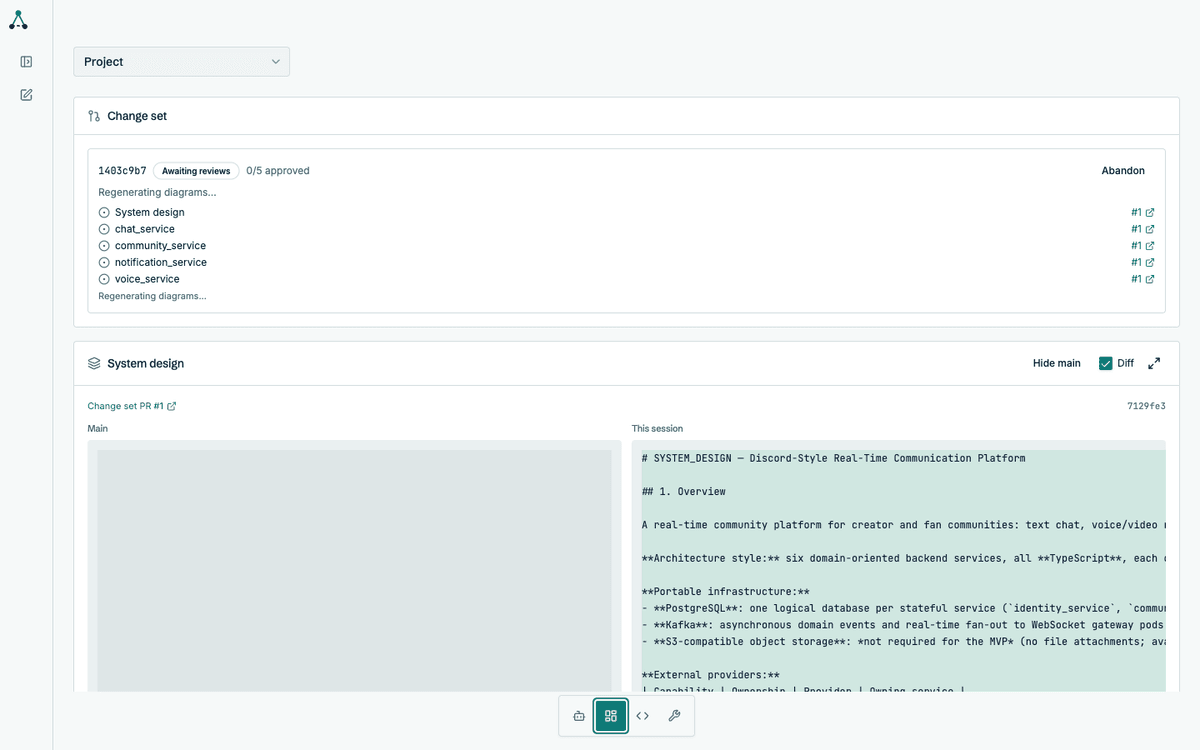
Each service also has its own diagram, produced during specification, showing its internal components rather than how it relates to the rest of the system. Both kinds ship in the repositories below.
Read the output
Section titled “Read the output”Every artefact Delta AI produces for a real project is in these repositories:
- The showcase — what was built and how to navigate it
- System design — the architecture document and its overview diagram
- chat_service —
the most representative service: rich domain logic, a transactional outbox, and
a fail-closed dependency on
community_service
Each service repository contains the same structure:
docs/architecture.md component boundaries, data flow, failure modesdocs/openapi_spec.yaml the complete HTTP contractdocs/user_stories.md testable acceptance criteriadocs/engineering_guide.md conventions the implementation followsdocs/decisions/ architecture decision recordsdiagrams/ the service diagram, .drawio and .svgsrc/ tests/ the implementation and its test suiteWhat the run produced
Section titled “What the run produced”| Measure | Result |
|---|---|
| Services | 6 |
| Pull requests | 7 (6 services + system design) |
| Tests written | 300+ across the services |
| Time from first prompt to merged | Under two hours |
What it demonstrates
Section titled “What it demonstrates”- Provider research — authentication, email and media were researched and chosen, not assumed
- Plan approval — every service’s specification was reviewed before implementation
- Specification quality — each service ships an OpenAPI contract, testable user stories and its own diagram, not just code
- Reviewability — the whole system arrived as seven reviewable pull requests